
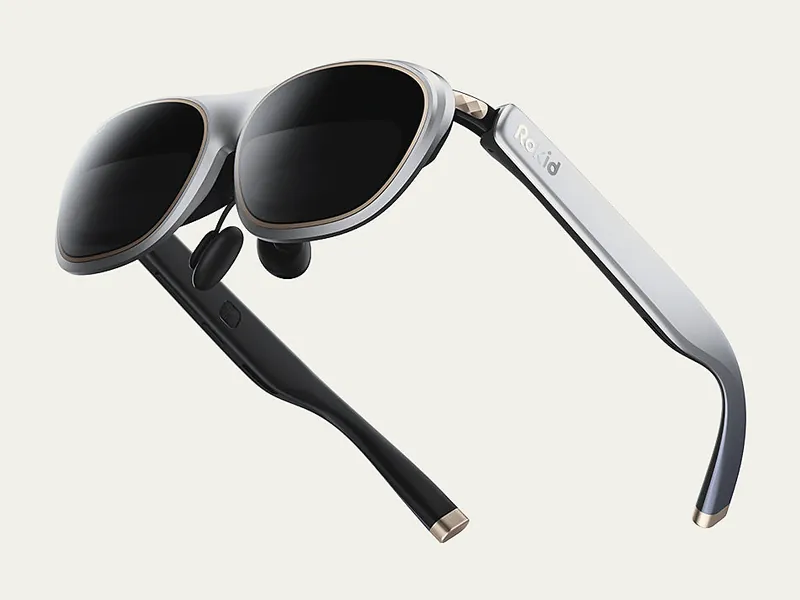
Short answer: yes. If you’re nearsighted, you can use most AR display glasses. They handle it in one of two ways. Some, like the Rokid Max 2 (the glasses in the Rokid AR Spatial bundle), have a focus dial above each lens. On the Max 2 the dials cover 0.00D to -6.00D, so mild to moderate myopia needs no extra lenses. Others, like the XREAL 1 Pro+ and VITURE Beast, have no dials. You add custom prescription inserts that clip in behind the display. If you have astigmatism, you’re farsighted, or your prescription is stronger than the dial range, you need inserts (or contact lenses) whichever brand you pick.
This is a guide based on manufacturers’ pages and published reviews, not a hands-on review. Every spec and price below links to its source, checked on October 31, 2026. I spent years in consumer-hardware PR, and I currently work at the company that makes the Rokid glasses covered here, so I’m not a neutral party on Rokid. The XREAL and VITURE details come straight from their own pages, and I link to them without affiliate links.
How myopia (diopter) adjustment works in AR glasses
Start with your eyeglass prescription. A minus number in the SPH (sphere) column means nearsighted, and a plus number means farsighted. A CYL (cylinder) value means you have astigmatism, and AXIS gives its direction. That’s how XREAL’s prescription order form explains it too. Diopters (D) are often written as “degrees” in Asia, so -6.00D is the same as “600 degrees.” How-To Geek describes the Max 2 dials that way, as 0 to 600 degrees.
What a built-in dial does:
- It refocuses the display for one eye. On the Max 2, TechRadar says a dial above each lens lets you “adjust the screen in real-time from 0.00D to -6.00D,” with no add-on lenses.
- It only corrects nearsightedness. Rokid says the built-in range is 0.00D (no correction) to -6.00D (for nearsightedness). It doesn’t correct farsightedness or astigmatism. For those, Rokid points to prescription lenses.
- Each eye is set separately. That matters if your eyes have different prescriptions. How-To Geek’s reviewer, who has monovision (one eye corrected for distance, one for near), singled out the separate per-eye dials.
- Easy to share. Because the correction is a setting rather than a custom lens, someone with different eyesight can turn the dials to their own number.
Dial ranges vary a lot by model, so check the exact model, not just the brand. VITURE’s own help center says its Luma goes to -6.0D, Luma Pro and Luma Ultra to -4.0D, and the Beast has no diopter adjustment.
What Rokid AR Spatial (Max 2 glasses) offers nearsighted users
The Rokid AR Spatial bundle pairs the Max 2 glasses with the Station 2 hub. For eyesight, the glasses are what matters:
- 0.00D to -6.00D myopia correction per eye. Rokid lists “Precision Vision 0.00D to -6.00D Myopia Correction” and “Myopia & Pupillary Adjustment” on the AR Spatial product page. TechRadar called the built-in adjustment “a massive benefit” for people who need it. Its buying advice says that if you wear glasses with a prescription in that range, the Max 2 will “save you having to pay extra for a lens insert.”
- IPD adjustment through Station 2. Pupillary distance (IPD) lines the optics up with your eyes. How-To Geek notes Station 2 is “the only way to adjust the IPD,” with no physical slider. That’s one reason the bundle, rather than the Max 2 alone, suits people who need it.
- Price. As of Oct 31, 2026, Rokid’s US store lists the AR Spatial at $399 (shown against a $549 regular price) and the Max 2 glasses alone at $249 ($399 regular). Prices change often, so check before you buy.
If the AR Spatial is on your list, my Rokid AR Spatial review roundup covers what reviewers liked and disliked, flights, gaming and the XREAL comparison.
Check Rokid AR Spatial priceI may earn a commission if you buy through this link.Astigmatism and strong prescriptions: you need inserts
A myopia dial can’t fix astigmatism. If your prescription has a CYL value, or your SPH is outside the dial range, plan on prescription inserts. These are small custom lenses on a frame that clips in between your eyes and the display.
- Rokid Max 2. Rokid says that if your prescription is outside the built-in range, or you’re farsighted or have astigmatism, the Max 2 “is compatible with additional prescription lens solutions,” and that lenses that fit the original Max also fit the Max 2. How-To Geek says greater correction needs “an insert and lens package solution through Lensology.” Rokid’s older Max lens-insert store listing returned a “404 Not Found” page on Oct 31, 2026, so check with Rokid or the lens maker for current options.
- Farsighted (plus) prescriptions. The Max 2 dials only go in the minus (nearsighted) direction. Rokid lists farsightedness among the cases that need additional prescription lens solutions.
- Mild astigmatism. If your CYL is small, you may find the dial alone is good enough. That depends on your eyes, though, and no brand promises it. Ask your optometrist, and buy from a store with a return window so you can check before you order custom lenses.
What you need to order inserts: a current eyeglass prescription (SPH, CYL and AXIS for each eye) and your pupillary distance (PD). Rokid’s lens-service FAQ asks for a valid eyeglass prescription plus PD. XREAL and VITURE ask for the same values. Custom lenses usually can’t be returned. XREAL says customized products are “non-returnable except for quality issues,” and VITURE says they are “not eligible for returns or exchanges.”
Can you wear contact lenses with AR glasses?
Yes. If your contacts fully correct your distance vision, you use AR glasses the way someone with no prescription would: on the Max 2, set the dials to 0.00D. Reviewers treat it as a normal option. Forbes Vetted’s VITURE Pro review is headed “Skip putting in your contacts” because that model’s dials made contacts unnecessary for its reviewer.
One catch when you order inserts later: Rokid’s lens FAQ says “contact lens and eyeglass prescriptions are not interchangeable,” so order inserts with an eyeglass prescription, not your contact lens numbers.
Wearing your regular glasses underneath is a different story. None of the official pages I checked (Rokid, XREAL, VITURE) offer it as their solution. Their answers are dials, inserts or prescription frames. Whether your frames fit under a pair depends on their size and lens thickness, so treat it as a stopgap rather than the plan.
How other major AR glasses handle prescriptions
| Built-in myopia dial | Prescription lenses / inserts | Notes | |
|---|---|---|---|
| Rokid Max 2 / AR Spatial | Yes, 0.00D to -6.00D per eye (Rokid) | Supported for stronger, farsighted or astigmatic prescriptions (Rokid) | IPD set in Station 2 software |
| XREAL 1 Pro+ | No, XREAL uses inserts | Official XREAL lenses, $59.90 ($159.90 regular) on XREAL’s US store; takes SPH, CYL, AXIS and IPD | Made by a third-party partner; about 10 business days delivery, shipped from China |
| XREAL One / One Pro | No (Forbes) | Official lens frames; XREAL’s user guide covers myopia, hyperopia and astigmatism | Frame models differ between XREAL generations |
| VITURE Beast | No (VITURE help) | Prescription lens frame included in the box (VITURE); frame with custom lenses listed at $79: SPH -16.00 to +12.00, CYL -6.00 to +6.00 (VITURE) | Single-vision lenses only; no progressives or bifocals |
| VITURE Luma / Luma Pro / Luma Ultra | Yes: Luma to -6.0D; Luma Pro and Ultra to -4.0D (VITURE help) | Custom lenses for stronger myopia or astigmatism |
Prices as listed on each brand’s US store, Oct 31, 2026.
How to read this. If you’re purely nearsighted within about -4.00D to -6.00D, glasses with dials save you an order, a wait and around $60 to $80. If you have astigmatism or a strong prescription, every brand sends you to custom lenses. Then compare the rest of the product (screen, comfort, price) and the insert’s price and range. XREAL’s inserts and VITURE’s lens frame both take SPH, CYL and AXIS, so all three brands can handle astigmatism with the right lenses. For the rest of that comparison between the two dial-versus-insert extremes, see Rokid AR Spatial vs VITURE Beast.
Not after a screen? AI glasses that take your prescription directly
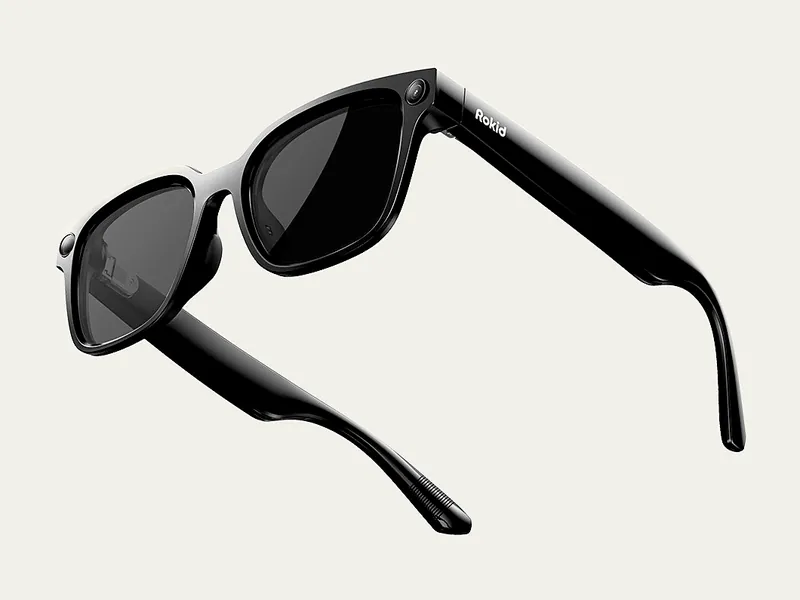
If what you actually want is everyday smart glasses (camera, open-ear audio, voice AI) rather than a private movie screen, prescriptions work differently. The lenses go into the frame like normal eyewear. Rokid’s non-display AI Glasses Style supports custom lenses “from -15.00D to +15.00D, including progressive, astigmatism and presbyopia options,” per Rokid, which notes that options vary by prescription and region. As of Oct 31, 2026, it’s $329 on Rokid’s US store ($399 regular). It has no display, so it isn’t a substitute for the AR glasses above.
Frequently asked questions
Do AR glasses work for people who are nearsighted?
Yes. Models with built-in myopia dials, like the Rokid Max 2 (0.00D to -6.00D per eye), let you dial in your correction with no extra lenses. Models without dials, like the XREAL 1 Pro+ and VITURE Beast, take custom prescription inserts that clip in behind the display.
Can I wear my prescription glasses under AR glasses, or do I need inserts?
The official solutions from Rokid, XREAL and VITURE are built-in dials or prescription inserts, not wearing glasses underneath. Whether your own frames fit depends on their size and lens thickness, so treat it as a stopgap. If you're nearsighted within a model's dial range, you may not need either.
Do myopia dials fix astigmatism?
No. Rokid says the Max 2 dials cover nearsightedness from 0.00D to -6.00D, and that farsightedness, astigmatism or stronger prescriptions need additional prescription lens solutions. If your prescription has a CYL value, plan on inserts or contact lenses.
What if each of my eyes has a different prescription?
Look for per-eye adjustment or order inserts with each eye's values. The Rokid Max 2 has a separate dial above each lens; How-To Geek's reviewer, who has monovision, singled this out. Insert order forms from XREAL and VITURE take separate SPH, CYL and AXIS values for the right and left eye.
Can I use contact lenses with AR glasses?
Yes. If your contacts fully correct your distance vision, use the glasses as you would with no prescription (on the Rokid Max 2, set the dials to 0.00D). If you later order inserts, use your eyeglass prescription: Rokid notes contact lens and eyeglass prescriptions are not interchangeable.
How much do prescription inserts for AR glasses cost?
As of October 31, 2026, XREAL's US store lists 1 Pro+ prescription lenses at $59.90 (regular $159.90), and VITURE lists the Beast prescription lens frame with custom lenses at $79. Custom lenses are generally non-returnable, so double-check your prescription and PD before ordering.
I'm farsighted. Will a myopia dial help?
No. Myopia dials only correct in the minus (nearsighted) direction. Rokid says farsighted users of the Max 2 should use prescription lens solutions, and VITURE's Beast lens frame accepts plus prescriptions up to +12.00.
What do I need to order prescription inserts?
A current eyeglass prescription (SPH, CYL and AXIS for each eye) and your pupillary distance (PD). Rokid's lens FAQ asks for a valid eyeglass prescription and PD, and XREAL's and VITURE's order forms ask for the same values.
Which Rokid AR glasses are best if I'm nearsighted?
If you're within -6.00D and have no significant astigmatism, the Rokid Max 2 glasses ($249 on Rokid's US store as of October 31, 2026) or the AR Spatial bundle ($399, adds Station 2 and software IPD adjustment) work with no inserts, using the per-eye dials.
Sources
All pages checked on October 31, 2026. Reviews are dated as published.
- Rokid AR Spatial product page (0.00D to -6.00D myopia correction, pupillary adjustment, price): https://global.rokid.com/products/rokid-ar-spatial
- Rokid Max 2 product page (price): https://global.rokid.com/products/rokid-max-2-ar-glasses
- Rokid, Can I use prescription lenses with the Rokid Max 2? (June 20, 2024): https://global.rokid.com/blogs/max-2/can-i-use-prescription-lenses-with-the-rokid-max-2
- Rokid lens service and FAQ (contact vs eyeglass prescriptions, ordering info): https://global.rokid.com/pages/lens-service
- Rokid AI Glasses Style product page (prescription range, price): https://global.rokid.com/products/rokid-ai-glasses-style
- How-To Geek, Rokid AR Spatial review (Bill Loguidice, Aug 27, 2025): https://www.howtogeek.com/rokid-ar-spatial-review/
- TechRadar, Rokid Max 2 review (Hamish Hector, June 22, 2025): https://www.techradar.com/computing/virtual-reality-augmented-reality/rokid-max-2-review
- XREAL 1 Pro+ prescription lenses (US store): https://us.shop.xreal.com/products/xreal-1-pro-plus-prescription-lenses
- XREAL One series user guide (prescription lenses): https://us.shop.xreal.com/blogs/buying-guide/user-guide_xreal-one-series
- VITURE help center, Which models support myopia (diopter) adjustment?: https://viture.gorgias.help/en-US/which-models-support-myopia-(diopter)-adjustment-2411625
- VITURE Beast product page (prescription lens frame in the box): https://www.viture.com/product/viture-beast-xr-glasses
- VITURE Beast prescription lens frame with lenses: https://www.viture.com/product/viture-beast-prescription-lens-frame-with-lenses
- Forbes Vetted, VITURE Pro XR glasses review: https://www.forbes.com/sites/forbes-personal-shopper/article/viture-pro-xr-glasses-review/