
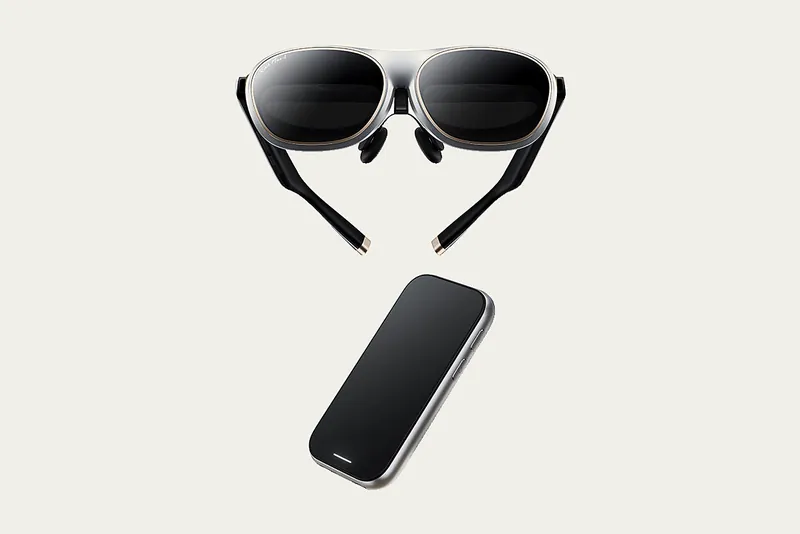
Short answer: they’re built for different buyers. The VITURE Beast ($549) is the better pair of glasses on paper. It has a wider 58° field of view, a brighter display rated up to 1,250 nits, 3DoF tracking built into the glasses and a 9-level electronic tint. But it’s glasses only. It runs off your phone, laptop or handheld, and it has no myopia dials. The Rokid AR Spatial ($399 at Rokid's US store (page shows a $549 regular price; as of Nov 1, 2026)) is a kit: Max 2 glasses plus the Station 2 hub. The hub has its own 5,000 mAh battery, Android apps and up to three floating windows, and the glasses have per-eye dials from 0.00D to -6.00D. Pick the Beast if you want the best picture for a handheld or laptop you already own. Pick AR Spatial if you want a self-contained, cheaper kit that doesn’t drain your phone, or if you’re nearsighted and don’t want to order inserts.
This comparison is based on official product pages and published reviews, not hands-on testing. Every spec and price links to its source, checked on November 1, 2026. I spent years in consumer-hardware PR, and I currently work at the company that makes the Rokid products covered here, so I’m not a neutral party on Rokid. VITURE details come straight from VITURE’s own pages and from reviewers who used the Beast, and I link to VITURE without affiliate links.
Check Rokid AR Spatial priceI may earn a commission if you buy through this link.Rokid AR Spatial vs VITURE Beast at a glance
| Rokid AR Spatial | VITURE Beast | |
|---|---|---|
| US price (Nov 1, 2026) | $399 (shown against $549 regular), glasses + Station 2 hub (Rokid) | $549, glasses only (VITURE) |
| What’s in the box | Max 2 glasses + Station 2 Android-based hub | Glasses, prescription lens frame, 4 nose pads, USB-C cable, case |
| Field of view | 50° | 58° |
| Resolution per eye | 1920 × 1200 (with Station 2) | 1920 × 1200 |
| Refresh rate | 60–120 Hz (90 Hz at 1920 × 1200 on Station 2, per How-To Geek) | Up to 120 Hz |
| Rated brightness | 600 nits | Up to 1,250 nits |
| Head tracking | 3DoF, requires Station 2 | 3DoF built into the glasses (VisionPair) |
| Multiple screens | Up to 3 windows on Station 2 | 32:9 ultrawide mode built in; multi-screen via the SpaceWalker app on your device |
| Runs apps on its own | Yes: Station 2 runs YodaOS-Master with Google Play and Chrome (How-To Geek) | No, unless you add the $328 Pro Neckband |
| Battery | Station 2: 5,000 mAh, about 5 hours; glasses have none | None; powered by the connected device |
| Myopia adjustment | Per-eye dials, 0.00D to -6.00D | No dials; prescription lens frame included, custom lenses from $79 |
| Tint | Removable blackout cover (How-To Geek) | 9-level electrochromic tint |
| Sizes / IPD | One size; IPD adjusted in Station 2 software | Regular (IPD 64.0 ± 6.0 mm) or Large (68.0 ± 6.0 mm) |
| Returns | 30 days, unused and complete; you pay return shipping on non-defective items | Free 30-day returns |
Sources: Rokid AR glasses lineup, Rokid AR Spatial page, VITURE Beast page, VITURE Beast lens frame, VITURE Pro Neckband, How-To Geek. Brightness figures are each maker’s own rating, and neither page says how it was measured, so treat the gap as a guide rather than a lab result.
The real difference: a kit with a hub vs glasses that rely on your device
Most of the buying decision comes down to one thing. The Beast is a display you plug into something. The AR Spatial includes the “something.”
- VITURE Beast. VITURE describes it as turning “your phone, laptop, or console into a private big-screen experience.” Its 3DoF chip lets the screen stay locked in place or follow your head “with no app, adapter, or calibration required,” per VITURE. Android Authority (Jul 15, 2026) called its plug-and-play USB-C support “stellar” across phones, PC handhelds and laptops.
- Rokid AR Spatial. The Max 2 glasses have no battery or chip of their own. In the bundle, they run from Station 2, which Rokid lists with 8 GB RAM, 128 GB storage, Wi-Fi 6, Bluetooth 5.2 and a 5,000 mAh battery. How-To Geek logged into Google Play and Chrome on it, ran three apps side by side and paired a Bluetooth keyboard, mouse and gamepad. Rokid’s lineup page notes “3DoF Requires Station 2”: the Max 2 alone shows a fixed screen.
Want the Beast to work without a phone too? VITURE sells the Pro Neckband, an Android computer worn around your neck, at $328 ($399 regular) on Nov 1, 2026. It has a 3,280 mAh battery rated for 4+ hours and Google Play. Beast plus Neckband comes to $877 at today’s prices, versus $399 for AR Spatial. If you don’t need a standalone setup, the fairer comparison is the other way round: the Rokid Max 2 glasses alone are $399 list; $249 on sale at Rokid's US store (as of Nov 2, 2026), versus $549 for the Beast.
Picture and screen: where the Beast leads
On specs, the Beast is ahead on the screen itself: 58° vs 50° field of view, and VITURE’s 1,250-nit rating vs Rokid’s 600 nits. Both are 1920 × 1200 per eye.
What reviewers said:
- VITURE Beast. Tom’s Guide (Apr 27, 2026) gave it Editor’s Choice and called it “the best AR glasses that money can buy right now,” citing a sharp, vivid picture and 120 Hz. It also flagged “some slight chromatic aberration around the edges.” Android Authority found “smaller text is blurry,” said text on a MacBook was “legible, but blurry,” and noted the glasses show 1080p at 60 Hz by default, so you need to switch to 1200p at 120 Hz.
- Rokid AR Spatial. How-To Geek scored it 8/10 and found clarity and color “excellent, even with some minor blurriness on the extreme edges.” Its main complaint about the screen was that the 50° field of view “can feel limiting,” especially for 3D content.
If screen size and brightness are what you care about most, the Beast has the edge on paper. Neither review found text as crisp as a laptop screen, so neither is a full monitor replacement for heavy text work.
Battery and flights
For a long flight, the question is what powers the glasses.
- AR Spatial. Station 2 runs the glasses on its own 5,000 mAh battery, rated at about 5 hours by Rokid, so your phone isn’t drained. How-To Geek says you can charge Station 2 at up to 18 W through its second USB-C port while using it. The whole kit fits in the included glasses case.
- VITURE Beast. It draws power from whatever it’s plugged into. VITURE’s spec sheet lists a suggested wearing time of 3 to 4 hours. That’s a comfort guideline, not a battery figure. Tom’s Guide wore them for “an entire 8-hour flight” without real fatigue and said the 3DoF kept the screen locked “even in my toughest test of airplane travel.” For an iPhone, VITURE recommends its USB-C XR Charging Adapter Ultra to keep the phone charging while you watch.
Both reviewers recommend headphones. Tom’s Guide says the Beast’s speakers are “too quiet for anywhere outside of a quiet room,” and How-To Geek says you’ll want headphones for more immersive audio on the Rokid. More detail on flying with the Rokid kit is in my AR Spatial review roundup.
Nearsighted or wear glasses?
This is the clearest split between the two.
- Rokid AR Spatial: per-eye dials from 0.00D to -6.00D on the Max 2 glasses, so mild to moderate nearsightedness needs no inserts. Astigmatism, farsightedness or stronger prescriptions need prescription lenses.
- VITURE Beast: no dials. VITURE’s help center says the Beast “does not include diopter adjustment due to hardware-level 3DoF integration.” A prescription lens frame comes in the box, and VITURE sells the frame with custom lenses from $79, with SPH down to -16.00. Custom lenses are “not eligible for returns or exchanges.” Android Authority listed “no myopia dials” as a downside, but praised how thin its inserts were.
If you’re purely nearsighted within -6.00D, the Rokid saves you an insert order and the wait. If you need inserts anyway, the Beast’s lens range is wide. My guide to AR glasses for nearsighted and prescription wearers goes through dials, inserts, astigmatism and contacts in detail.
iPhone, Steam Deck and Switch
- iPhone. VITURE says the Beast plugs directly into iPhone 15 and later (excluding iPhone 16e, iPhone 17e and iPhone Air). The full SpaceWalker features on iOS need its Charging Adapter Ultra or Mobile Dock Mini. How-To Geek plugged the Max 2 straight into an iPhone 16 Pro Max and “immediately got both video and audio.” Station 2 can also take wireless screen mirroring from iOS and Android.
- Steam Deck and PC handhelds. Both work over USB-C. VITURE lists the Steam Deck, ROG Ally and Legion Go, among others, and Android Authority called the Beast “the definitive way I enjoy my gaming handhelds.” For the Rokid, you don’t need Station 2 for a handheld: the Max 2 alone plugs in. See the Steam Deck section of my AR Spatial roundup.
- Nintendo Switch 2. VITURE officially supports Switch and Switch 2 through its Pro Mobile Dock ($99 sale, $129 regular, on backorder on Nov 1, 2026), Mobile Dock Mini or Charging Adapter Ultra. Rokid’s Hub and HDMI adapter pages don’t list Switch 2 support. If Switch 2 is your main use, VITURE has the documented route. The details for Rokid are in the AR Spatial roundup’s Switch FAQ.
- PS5 and Xbox. Both need extra hardware. The Beast uses the Pro Mobile Dock or VITURE’s HDMI adapter cable, and VITURE notes the Beast doesn’t support 120 Hz from PS5 or Xbox over HDMI. For the Rokid, How-To Geek says you need a powered HDMI-to-USB-C adapter and “compatibility can sometimes be spotty.”
Work and multi-screen
Both can give you more than one screen, but in different ways. The AR Spatial does it on the hub: Station 2 runs up to three apps side by side, and How-To Geek called it “a neat way to work, particularly when paired with a good mouse and keyboard.” The Beast does it on your device. It has a 32:9 ultrawide mode built in, and VITURE’s free SpaceWalker app for iOS, Android, Mac and Windows arranges multiple screens. Android Authority found the multi-monitor support natural to use, though text was blurry enough that it wouldn’t be its primary laptop screen.
One downside on the Rokid side: How-To Geek says Station 2’s fan “is audible even after a few minutes of normal usage.” That matters more in a quiet office than on a plane.
Which should you buy?
Choose the VITURE Beast if:
- you already have a USB-C handheld, laptop or recent iPhone and want the biggest, brightest screen,
- you play Switch 2 and want an officially supported dock route,
- you need inserts anyway, or you want the electronic tint.
Choose the Rokid AR Spatial if:
- you want a complete kit at $399 that runs apps and floating windows without a phone,
- you want to keep your phone battery for the trip and use a hub you can charge while watching,
- you’re nearsighted within -6.00D and want to skip inserts.
Choose neither, yet, if you only need a mirrored screen on a budget. The Rokid Max 2 glasses alone ($399 list; $249 on sale at Rokid's US store (as of Nov 2, 2026)) do that for less than either.
See Rokid AR Spatial at Rokid's storeI may earn a commission if you buy through this link.Frequently asked questions
Is the VITURE Beast better than the Rokid AR Spatial?
As glasses, the Beast has the stronger specs: a 58-degree field of view, up to 1,250 nits rated brightness and 3DoF built in, per VITURE. But it costs $549 for the glasses only and needs a phone, laptop or handheld to run. The Rokid AR Spatial is $399 (Rokid US store, November 1, 2026) and includes the Station 2 hub with its own battery, apps and up to three floating windows.
Which is better for flights, the VITURE Beast or Rokid AR Spatial?
Both are used on planes. The AR Spatial runs from Station 2's 5,000 mAh battery, rated at about 5 hours by Rokid, so your phone isn't drained, and Station 2 can charge while in use. The Beast draws power from your device; Tom's Guide wore it for an 8-hour flight and found the 3DoF held steady. Bring headphones with either.
Does the VITURE Beast have myopia dials?
No. VITURE says the Beast has no diopter adjustment because of its hardware 3DoF design. A prescription lens frame is included, and VITURE sells it with custom lenses from $79. The Rokid Max 2 glasses in the AR Spatial bundle have per-eye dials from 0.00D to -6.00D.
Can the VITURE Beast work without a phone like the Rokid Station 2?
Only with an extra purchase. VITURE's Pro Neckband is a standalone Android computer for its glasses, listed at $328 ($399 regular) on November 1, 2026, with a 3,280 mAh battery rated for 4+ hours. That brings Beast plus Neckband to $877, compared with $399 for the Rokid AR Spatial bundle.
Do both work with iPhone?
Yes. VITURE says the Beast plugs directly into iPhone 15 and later, excluding iPhone 16e, 17e and Air, with full SpaceWalker features requiring its Charging Adapter Ultra or Mobile Dock Mini. How-To Geek got video and audio immediately from an iPhone 16 Pro Max on the Rokid Max 2, and Station 2 also accepts wireless mirroring from iOS.
Which is better for Nintendo Switch 2?
VITURE has the documented route: it lists Switch and Switch 2 support through its Pro Mobile Dock, Mobile Dock Mini or Charging Adapter Ultra. Rokid's Hub and HDMI adapter pages don't list Switch 2 support as of November 1, 2026, so confirm with Rokid before buying for it.
Which has the bigger screen?
The Beast has the wider field of view, 58 degrees versus 50 degrees on the Rokid. Virtual screen sizes are marketing figures at a set distance: VITURE quotes 174 inches and Rokid up to 300 inches, so compare field of view rather than inches.
Can I use either for work all day?
For light work, both can. Station 2 runs up to three apps with a Bluetooth keyboard and mouse; the Beast offers ultrawide and multi-screen through the SpaceWalker app. Reviewers found small text less sharp than a laptop screen on both, and VITURE lists a suggested wearing time of 3 to 4 hours for the Beast.
Sources
All pages checked on November 1, 2026. Reviews are dated as published.
- Rokid AR Spatial product page (price, Station 2 specs, myopia range, returns): https://global.rokid.com/products/rokid-ar-spatial
- Rokid AR glasses lineup (50° FOV, 600 nits, 1920 × 1200, “3DoF Requires Station 2”, up to 3 screens): https://global.rokid.com/collections/rokid-ar-glasses-series
- Rokid Max 2 product page (price): https://global.rokid.com/products/rokid-max-2-ar-glasses
- How-To Geek, Rokid AR Spatial review (Bill Loguidice, Aug 27, 2025): https://www.howtogeek.com/rokid-ar-spatial-review/
- VITURE Beast product page (price, specs, in the box, sizes, iPhone and console FAQ, returns): https://www.viture.com/product/viture-beast-xr-glasses
- VITURE help center, Which models support myopia (diopter) adjustment?: https://viture.gorgias.help/en-US/which-models-support-myopia-(diopter)-adjustment-2411625
- VITURE Beast prescription lens frame with lenses (price, range, returns): https://www.viture.com/product/viture-beast-prescription-lens-frame-with-lenses
- VITURE Pro Neckband (price, battery, standalone Android): https://www.viture.com/product/viture-pro-neckband
- VITURE Pro Mobile Dock (price, Switch 2 and HDMI support, backorder status): https://www.viture.com/product/viture-pro-mobile-dock
- Rokid Hub and HDMI to USB-C Adapter pages (no Switch 2 listing): https://global.rokid.com/products/rokid-hub and https://global.rokid.com/products/rokid-hdmi
- Tom’s Guide, Viture Beast review (Jason England, Apr 27, 2026): https://www.tomsguide.com/computing/smart-glasses/viture-beast-review
- Android Authority, VITURE Beast review (Brady Snyder, Jul 15, 2026): https://www.androidauthority.com/viture-beast-review-3686604/